




How to Choose Clear Plastic Bags by Size and Pack Quantity
Most packaging returns happen for one reason: the bag was the wrong size, not poor quality. A clear plastic bag that fits snugly around your product saves you the cost of a return and the time spent repacking an order. For retail and food sellers, a clear OPP bag also does a second job: it lets the customer see exactly what they are buying before they open anything. Get the size and the pack quantity right the first time, and you avoid both problems at once.
Sizing a bag is a simple measurement task, not a guess. Measure your product's width, length, and height, then add a few millimetres of slack so the item slides in without forcing the seal. A 50mm x 100mm bag with a 30mm lip, for example, fits small items like jewellery, stickers, or bakery goods, while the extra lip gives you room to fold and reseal without crushing the contents. Quantity depends on your order volume: a single pack suits a small shop testing a new product line, while a bulk order of 10,000 bags suits a store that moves stock daily and needs a steady supply on hand without reordering every week.
Table of Contents
Clear Bag Sizes and Micron Options at a Glance
Micron thickness measures how much plastic film is used per bag, and it decides how much weight or rough handling the bag can take. A light 25 to 30 micron bag suits soft goods like clothing, stickers, or bakery items that don't push against the plastic, while anything 40 micron and up holds its shape under sharper edges, like small hardware or retail multi-packs. The Box Packery breaks down thickness ranges by use case in more detail if you want the engineering side of it, see how thick poly bags should be for different uses.
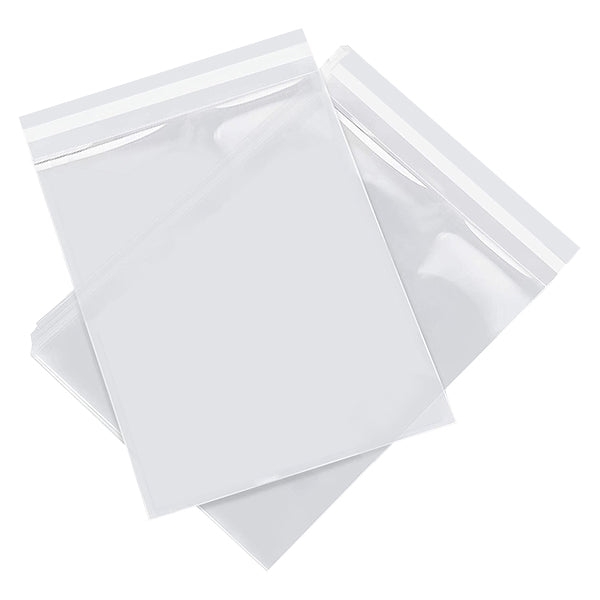
50 x 100mm + 30mm OPP Cellophane Resealable Plastic Bags
OPP cellophane is the material you'll see on most clear bags sold for retail and food, because it stays optically clear even after months on a shelf and it meets food-contact standards without added coatings. Ziplock-style bags are a separate category built for repeated opening and closing rather than a single reseal, so they suit storage and larger parts bins more than retail display. The table below lines up common sizes against the jobs they're built for.
| Size | Typical micron | Best for |
|---|---|---|
| 50 x 100mm + 30mm lip | 30-40 micron | Jewellery, bakery items, small parts |
| 160 x 225mm | 35-40 micron | Clothing, stationery, small retail goods |
| 260 x 360mm | 40 micron | Apparel multi-packs, documents |
| 300 x 425mm | 40 micron | Larger garments, bulk storage |
| 455 x 540mm | 40 micron plus | Bedding, bulky retail stock |
If your product sits between two rows, size up rather than down. A bag that's slightly loose still protects the item, but one that's too tight will stress the seal and split under weight, so the range of clear plastic bags is worth scanning by size before you commit to a quantity.
Pick Your Clear Plastic Bag Size by What You're Packing
Start with what sits in your hand, not the bag catalogue. The 50 x 100mm + 30mm lip bag is the size most small sellers reach for first, because it covers earrings, stickers, buttons, small baked goods, and screws or other small hardware parts without wasted film around the edges.
The extra 30mm lip adds capacity without changing the footprint of the bag, so a thicker batch of biscuits or a handful of washers still seals flat instead of bulging against a straight-cut top.
- Earrings and stud pairs
- Stickers and decals
- Buttons and small badges
- Macarons or single bakery items
- Screws, washers, and small hardware parts
Before you order, lay the product flat and measure its longest flat side, then add 10-15mm clearance so it slides in without stretching the seal. Skip this step and you end up with a bag that looks right on screen but splits the first time someone opens it.
Single Pack or Wholesale Carton, Which Order Fits
A single pack suits a store testing a new product line or packing fewer than a few hundred orders a week. A carton of 10,000 suits a shop packing daily orders, running a stall at a weekly market every week, or restocking a product line that already sells at a steady pace.
Storage matters as much as sales volume here. A warehouse setup like 115A Silverwater Rd, Silverwater can hold pallets of bulk stock, but a small shopfront with limited back-room space often can't, so the right pack size depends on the shelf or cupboard you actually have free.
- Weekly order count under 100: start with a single pack
- Weekly order count over 500: a 10,000-unit carton covers roughly ten to twenty weeks
- Storage space under one square metre: avoid full cartons
- Seasonal spikes only: a single pack avoids tying up cash in stock you don't need year-round
Running out mid-week costs more than the bag itself, since a delayed order can mean a delayed customer refund or a late dispatch.
Pack smarter. Ship with confidence.
Everything you need to pack, protect and send.
Discover dependable packaging for eCommerce, retail and wholesale—selected for quality, value and hassle-free shipping across Australia.
- Low minimum orders
- Samples available
- Australia-wide delivery
Work Out Cost Per Bag Before You Order
The small pack at 3.22 USD works out to roughly 6.4 cents per bag, which is fine for testing a new line or filling a handful of weekly orders. The wholesale carton of 10,000 at 239.95 USD brings that down to roughly 2.4 cents per bag, a saving that only pays off once your weekly usage clears the break-even point.
- Count how many bags you used last week, not what you expect to use
- Multiply that weekly number by the weeks until your next planned reorder
- Compare the total against the 10,000-unit carton to see if it lasts a useful stretch rather than sitting in storage for a year
If your weekly count is under 50 bags, a single pack keeps cash free for other stock. Above a few hundred a week, the per-bag saving on the carton adds up fast enough to justify the larger upfront spend.
Match the Bag to Food, Retail or Storage Use
Food packaging needs a food-safe OPP film and a tight reseal, since loose seals let air in and stale out baked goods faster than the packaging failing outright. Retail display works best with crystal-clear film, because customers decide on a product by sight before they ever pick it up off the shelf.
Storage and small parts organising is a different job again, built around opening and closing the same bag many times rather than sealing it once. A 160 x 225mm ziplock clear resealable plastic bag handles that kind of repeated use better than a single-lip seal, which is designed for one close rather than daily access.
- Food items: food-safe OPP, tight reseal, no added coatings
- Retail display: crystal-clear film, flat-fold presentation
- Small parts storage: ziplock closure, repeated opening
- Bulk components: a 120 x 160mm ziplock bag for a bin of mixed hardware
Pick the feature that matches the task, not the bag that looks closest in size, since a reseal built for one close will wear out fast under daily handling.
Clear Film or Low Price, Which Costs Less Later
A cheaper bag with cloudy or thin film costs more once you count the returns it causes. Handmade soap, jewellery, or baked goods look faded or second-hand through hazy plastic, even when the product inside is fine. Shoppers judge quality by what they see first, so a dull bag undercuts a product that would otherwise sell itself.
A weak reseal lip creates a different cost: spoilage complaints after the sale, not before it. If the lip doesn't hold a tight seal, air gets into baked goods or food items within a day or two, and the customer who opens a stale product asks for a refund rather than a replacement bag. That refund, plus the time spent handling the complaint, is usually worth more than the few cents saved on a thinner bag.
Film thickness decides how often a bag tears during packing, not just how it looks on a shelf. A 40 micron bag holds up under daily handling, so a packer running through a few hundred orders doesn't stop to replace split bags partway through a shift. Thinner film in the 20 to 25 micron range tears more often under the same repeated handling, which slows down a high-volume packing run rather than speeding it up.
| Film choice | Shelf appearance | Risk under daily handling |
|---|---|---|
| 20-25 micron, low clarity | Dull, products look faded | Tears often in high-volume packing |
| 30-35 micron, mid clarity | Clear but soft lip | Reseal fails under light pressure |
| 40 micron, crystal clear | Sharp, shows product detail | Holds up through repeated daily use |
Weigh the unit price against what a return or a refund actually costs you in time and stock. The tips on choosing the right plastic bag make the same point from a different angle: the bag's job is to protect the sale, not just hold the product.
Place Your Order Based on Weekly Bag Count
Check your product against the 50 x 100mm + 30mm lip before you buy anything, since that measurement decides whether the bag seals flat or strains at the edges. If you're packing fewer than a few hundred orders a week, order the single pack and run it through a real packing session before committing to more. Once you're past that mark and packing daily, move straight to the 10,000-unit carton rather than reordering small packs week after week. Both sizes sit in Packee's catalogue ready to order, and if you're placing a bulk order outside the standard carton size, sales@packee.com.au can sort out the quantity and freight before you pay for anything.
Common Questions About Clear Plastic Bags
Can I get a custom size made if 50 x 100mm doesn't fit my product?
Custom sizing is something you'd need to ask a supplier about directly, since it isn't a standard catalogue item. Email sales@packee.com.au with your product dimensions and order volume, and they can tell you whether a custom run makes sense or whether one of the existing sizes already covers your item with a bit of extra clearance.
Do clear OPP bags yellow or go cloudy if stored for a long time?
OPP film holds its clarity for years when stored away from direct sunlight and heat. Yellowing happens when plastic film sits near a window or a heat source for months, since UV and warmth break down the polymer faster than normal shelf storage. Keep bulk stock in a cupboard or back room rather than a sunlit counter and the film stays crystal clear until you use it.
Is the 30mm lip strong enough to reseal multiple times without tearing?
The lip handles a handful of reseals before the fold line starts to weaken. It's built for the pack-reopen-reseal cycle a customer does a few times after delivery, not for daily opening over weeks. For a bag that needs opening and closing on a regular basis, a ziplock style holds up better than a single-lip seal.
Can I use the same clear bag for both food items and retail merchandise?
Yes, as long as the bag is food-safe OPP film, which both the single pack and the 10,000-unit carton are. The same bag that holds a macaron can hold a pair of earrings or a sticker pack without any issue, since food-safe film meets a higher standard than non-food retail film, not a different one.