



How to Buy Cardboard Boxes in Bulk for Shipping or Storage
Buying a carton of 20 boxes instead of grabbing single units one at a time can cut your per-box cost by close to half, which is the whole reason bulk buying makes sense once your order volume picks up. Running out of boxes mid-month is one of the most common problems for online sellers, and it is entirely avoidable with a bit of planning around reorder points. Most suppliers split their range into die-cut boxes for a polished look and standard corrugated cartons for everyday shipping, so the buying decision usually comes down to matching the box type to what you actually send out.
A small business posting five orders a day burns through boxes faster than most owners expect, often needing a fresh batch every two to three weeks once sales pick up. Corrugated slotted cartons in B flute are the standard choice for books, spare parts, and general retail goods because they resist crushing during transit and hold up in a stack. Die-cut mailer boxes suit brands that want a cleaner unboxing moment, since they fold flat, assemble without tape, and still protect smaller items like accessories or gifts. Working out which one your product needs, and how many you go through in a month, is the first real step to buying in bulk properly.
Table of Contents
Why Businesses Switch to Bulk Box Orders
Ad-hoc buying means placing a small order every time stock gets low, which usually means once a week for a busy online shop. Bulk buying flips that around: you place one larger order and stop thinking about boxes for months. The trade-off is storage, since a pallet of flat-packed cartons takes up real floor or shelf space that a small business needs to plan for.
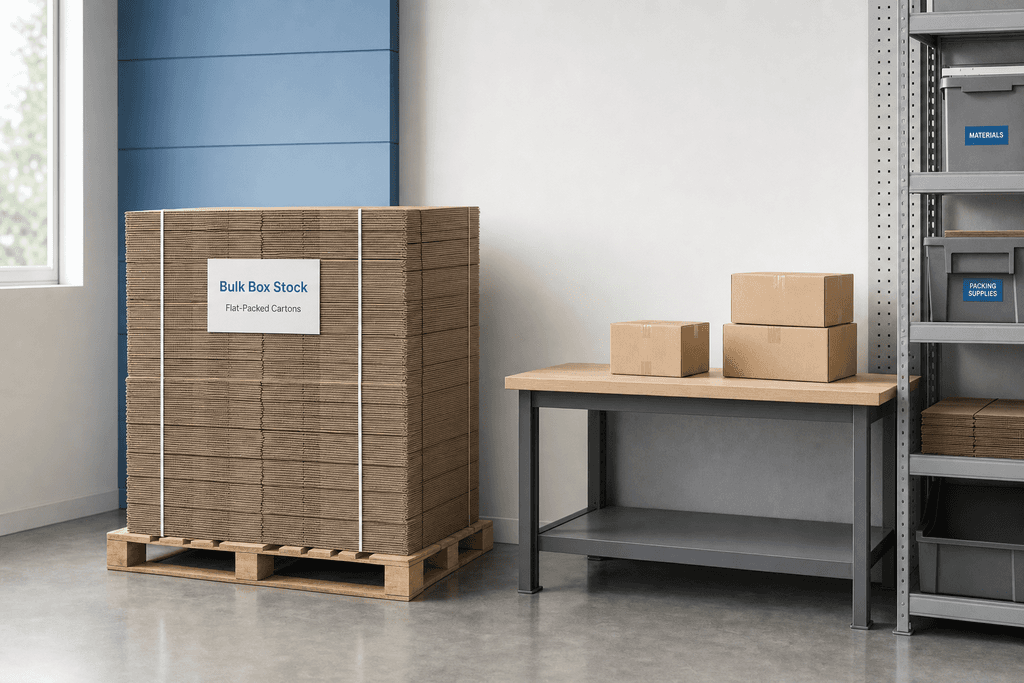
Retailers with steady, predictable volume tend to move to bulk first, because they can forecast how many boxes a quarter actually needs. Businesses with seasonal spikes often stay on smaller, more frequent orders until their sales pattern settles. Either way, the goods have to sit somewhere, so measure your storeroom or stockroom before committing to a large pallet delivery.
| Order size | Typical buyer | Reorder frequency |
|---|---|---|
| 50-100 boxes | New or low-volume seller | Every 2-3 weeks |
| 500-1,000 boxes | Established online store | Every 2-3 months |
| 2,000+ boxes | High-volume retailer or warehouse | Twice a year or less |
Dropping from weekly reorders to two deliveries a year is the main reason store managers make the switch, since it frees up time spent on admin and freight coordination. A heavy-duty cardboard box range is worth checking if the bulk order also needs to survive rougher freight handling. Racerboxes has a useful rundown of cost-saving tips for bulk cardboard box orders if freight and pallet space are the deciding factor for your business.
Work Out How Many Boxes You Actually Need
Start by counting how many parcels or storage items you pack in an average week, then multiply that number by four to get a monthly figure. A shop packing 40 orders a week needs roughly 160 boxes a month before you even factor in anything else. That single calculation is the base number every bulk order should start from.
Sales periods change that number fast, so add a seasonal factor before you place an order. Black Friday, EOFY sales, or a product launch can double or triple weekly parcel counts for two to four weeks straight, and a bulk order sized for a normal month will run out halfway through a promotion. Add 10-15% on top of your calculated total to cover boxes damaged in storage, used for internal testing, or wasted on packing mistakes.
- Count parcels or items packed per week over a typical month
- Multiply that weekly average by four
- Add a seasonal buffer for known sale periods
- Add 10-15% on top for waste and damage
- Round up to the nearest bulk pack size the supplier sells
Ordering short means paying for rush freight and a second delivery within weeks. Ordering too heavy ties up cash in stock that sits on a shelf instead of funding the next batch of inventory, so this number is worth getting right before you check out.
Match the Box Type to What You're Packing
The right box depends on what you're sending, not just what looks good in photos. A 310 x 230 x 105mm die-cut box in matte black finish suits gifts, accessories, and small retail items where the unboxing moment matters to the buyer. A 250 x 150 x 150mm brown corrugated carton is built for books, spare parts, and general retail stock that needs strength over presentation, while a 195 x 195 x 350mm carton in the same B flute construction gives extra depth for taller items or bundled multi-packs.
- Small gifts or accessories that need a premium look: die-cut box in matte black
- Books, spare parts, or general stock: 250 x 150 x 150mm brown carton
- Taller or bundled items: 195 x 195 x 350mm brown carton
- Brand-forward online store: matte black finish over standard brown
Matte black reads as a premium brand choice, while plain brown corrugated reads as practical and cost-focused, and neither is wrong for the right product. Match the box to the product first, then the finish to the brand. Sellers moving heavier or awkward-shaped stock might also want to check a heavy duty cardboard box range built for rougher handling.
Pack smarter. Ship with confidence.
Everything you need to pack, protect and send.
Discover dependable packaging for eCommerce, retail and wholesale—selected for quality, value and hassle-free shipping across Australia.
- Low minimum orders
- Samples available
- Australia-wide delivery
Compare Bulk Pricing Before You Order
Box prices scale with size and construction, and the three options here range from $14.95 to $21.95 per unit (AUD) before any bulk discount. The 250 x 150 x 150mm brown carton sits at the lower end because B flute single-wall corrugated is cheaper to produce than a die-cut box, while still giving solid crush resistance for shipping and stacking. The 310 x 230 x 105mm die-cut box costs more per unit because of the tooling and finish, and the taller 195 x 195 x 350mm carton costs more again due to the extra material.
- Ask the supplier what price break applies at 100, 500, and 1,000 units
- Check whether freight is included in the quoted per-box price
- Confirm minimum order quantity for the bulk discount to apply
- Work out cost per box, not just the total invoice amount
Always compare cost per box across pack sizes, since a bigger total spend can still mean a lower unit price. The Fibre Box Association notes that corrugated packaging remains one of the most cost-effective shipping materials available, which lines up with why B flute stays the default for high-volume sellers.
Place Your Bulk Order and Arrange Delivery
Placing a bulk order starts on the product page, where you select box size and pack quantity before checkout. Confirm your delivery address carefully if the order is large enough to arrive on a pallet, since a residential address or a small shopfront may not suit a full pallet drop. Lead times matter too, so check dispatch and delivery windows before a known sale period rather than after stock runs low.
- Select the correct box size and pack quantity on the product page
- Confirm a delivery address suited to pallet-sized freight if ordering in volume
- Check lead times against your next sale or restock date
- Email sales@packee.com.au for a custom quote on large or mixed bulk orders
Custom bulk quotes are handled directly by the sales team, which is worth doing if you need a mix of sizes across die-cut and corrugated stock in one delivery. Packee's warehouse at 115A Silverwater Rd, Silverwater, NSW 2128 processes these orders for pickup or freight depending on volume. Getting the address and timing right the first time avoids a second freight bill on top of the box order itself.
Choosing Between a Pallet Load and a Mid-Size Pack
Bulk pricing only pays off if you have somewhere to put the boxes. A pallet of 2,000 units might cut your per-box cost by another 10 to 20 percent on top of the standard bulk discount, but it can take up a full pallet bay in your storeroom for months. A small retailer working out of a single shopfront or a spare room rarely has that kind of floor space to spare.
Mid-size packs solve that problem without giving up the savings entirely. An order of 500 to 1,000 units still gets a meaningful discount over ad-hoc buying, fits on a couple of shelves, and reorders every two to three months instead of twice a year. That middle ground suits most small to mid-size online stores better than a pallet drop, especially if the shopfront doubles as the packing area.
| Order size | Storage needed | Best fit |
|---|---|---|
| 50-100 boxes | Single shelf | New seller testing volume |
| 500-1,000 boxes | A few shelves or a small rack | Space-limited shopfront or home business |
| 2,000+ boxes | Pallet bay or warehouse corner | Warehouse with dedicated storage |
Flat-packed cartons help either way, since they take up a fraction of the space assembled boxes would, letting you fit more stock into the same shelf run. A shop moving smaller items might look at a 220 x 160 x 100mm die-cut option, which stacks flat in a much smaller footprint than a bulkier carton size.
Reordering too often is the real cost most owners miss. Placing five small orders a year instead of one mid-size bulk order can wipe out most of the per-unit savings once freight and admin time are added back in, so the goal is to find the largest pack size your storage can actually hold.
Choose Your Box Size and Place the Order
Pick the size that matches what you're currently packing, then order enough to cover at least a month, plus the 10-15% buffer already worked out above. Waiting for a better deal or a bigger discount just delays the point where you actually stop running out of stock. If your order needs a mix of sizes, or a quantity beyond what's listed on the product page, email sales@packee.com.au directly and Packee can put together a custom bulk quote rather than forcing you into a standard pack size. That one email, sent today, is the difference between sorting your packaging for the next few months and reordering small batches every couple of weeks.
Bulk Box Buying Questions
Can I mix different box sizes in one bulk order?
Yes, most suppliers let you combine sizes in a single bulk order, though the standard bulk discount is usually tied to hitting a quantity threshold on one product. Mixing sizes often means a custom quote rather than an automatic checkout discount. If your monthly packing needs both die-cut and corrugated stock, ask for a combined quote before ordering separately, since separate small orders lose the price break entirely.
How long do flat-packed cardboard boxes stay in good condition in storage?
Flat-packed corrugated cartons stay in good shape for at least 12 months if kept dry, out of direct sun, and off a damp floor. Moisture is the main enemy, since it softens the fluting and weakens crush resistance long before the cardboard looks damaged. Stack packs on a pallet or shelf rather than a concrete floor, and rotate older stock to the front so nothing sits unused for a year or more.
What happens if my bulk order arrives damaged?
A damaged bulk delivery should be reported to the supplier straight away, ideally with photos of the pallet or carton before you move or unpack it. Freight damage is usually covered by the carrier or supplier, but only if it is flagged on delivery or within a short window afterward. Keeping the packing slip and delivery docket makes any replacement or credit claim faster to process.
Is it worth buying boxes in bulk before I know my exact monthly volume?
No, guessing at volume before you have a few weeks of real order data usually leads to an oversized order sitting on a shelf. Track actual parcel counts for at least a month first, then size the bulk order to that number plus a buffer. A new seller is better off starting with a smaller pack and moving to bulk once sales settle into a pattern.